One of the best ways how to monetize your YouTube channel is by creating a community for your biggest fans and supporters.
One of the most convenient platforms available for this task is called Patreon. It's an amazing tool for any YouTube channel who wants to make money with their videos, even if they’re not yet monetized!
In this article I am going to show you the ins and outs of creating your own membership site on Patreon itself.
How to Earn More Money on Patreon?
Patreon is one of the oldest and most popular platforms to monetize your YouTube channel outside the YouTube partner program.
In many ways, Patreon is similar to YouTube. Most YouTube channels have little to no subscribers and earn little to no money. Similarly, the majority of Patreon creators have very few paying members and earn less than $100 per month.
But that’s none of our concerns. I will show you how you can get the best possible results, by hacking the system to become the exception to the rule.
To earn more money on Patreon account you have to master five goals.
- Get more YouTube subscribers.
- Motivate your subscribers to visit your Patreon page.
- Convert more visitors to your Patreon page into paying members.
- Increase the average monthly spend per paying member.
- Maximize the customer lifetime value and retention rate. How many months does someone stay a paying member? And how can you prevent them from leaving?
After reviewing hundreds of successful content creators who mastered these five goals on their Patreon page I've identified seven strategies and key success factors that will help you to achieve the best possible results for your Patreon page.
- Optimize your pricing structure to maximize profits.
- Design attractive membership perks and tiers to sign up more paying members.
- Benefit from economics of scale by creating scalable content.
- Create premium, high-quality gated content that's exclusively available for your Patreon subscribers.
- Turn your Patreon homepage into a high-converting sales page.
- Learn how to promote your Patreon page.
- Discover how to promote your gated premium content on Patreon.
By the way, I recently launched my own Patreon account for my YouTube channel, where I implement all of my recommendations in this article. So if you’re looking for a bit of inspiration, check out my link.
How Much Money Can You Make on Patreon?
According to Patreon's research, the average creators are able to convert between 0.15 % to 0.75 % of their total YouTube subscribers to paying Patreon contributors.
If you think about it, that’s quite a small number...
Let’s see how much money this would generate for a small YouTube channel with 1,000 subscribers.
With 1,000 subscribers you might be able to convert between 1 and 8 subscribers into paying patrons. Let's take something in the middle as an example, I am going to pick 4 for my calculations.
In the same article, Patreon explains that in a typical reward tiers structure of $2, $5, $10, $25, and $100, the average user will pay around $7 per month.
This gives us expected earnings of about $28 per 1,000 YouTube subscribers per month (4 patrons x $7 per month).
Let's see what happens if we grow our YouTube channel with more subscribers.
- 1,000 subscribers = $28
- 10,000 subscribers = $280
- 50,000 subscribers = $1,400
- 100,000 subscribers = $2,800
- 1,000,000 subscribers = $28,000
Obviously, that's not ideal, it would take a while to hit 1 million subscribers. If you want to make this a living on YouTube with your Patreon account, we have to find a better way how we can scale things up more quickly with a lower number of subscribers.
Pricing
Should you charge your patrons every month or per-creation?
Before we talk about the ideal pricing, let's have a quick chat about some of Patreon's fundamentals.
Patreon gives you two options how you can monetize your community: monthly recurring payments or payment per creation or upload.
With monthly recurring payments your patrons are charged automatically once per month.
With payment per upload, you have to create a community post on your Patreon page and mark it as “paid content”. You can publish multiple paid posts per month, but keep in mind that some of your members might cap the amount they're willing to contribute.
Which of these two options should you chose?
Let’s have a look at what the majority of content creators are doing. According to Patreon, 77% of creators chose monthly recurring payments. And I totally agree!
There are many good reasons, why monthly recurring payments are better than getting paid per creation or upload:
Cash-flow is king.
Your monthly expenses such as rent and groceries will mostly be the same, month over month.
If you want to make YouTube your full-time job, it's important to create long-term financial stability, so you don't have to worry about being able to pay rent every month. Because of that, monthly payments on Patreon are perfect for this.
Patreon's members prefer predictability
It's also better for your patrons. They know exactly how much money they’re going to spend month over month. If you've had an exceptionally busy month and uploaded 8 videos, this could easily break someone's bank account on a per upload basis.
It motivates you to be more consistent
If you get paid per creation or upload, it's easy to procrastinate or to succumb to perfectionism. After all, you don’t owe them anything. They only pay you when you upload something new.
If you ask your patrons to commit to a monthly payment on the other hand, it puts pressure on you to create content more consistently, because your members expect to see content!
This is a very helpful side effect to many creators and creates accountability with your audience.
It eliminates perfectionism
Another problem with payment per upload is the decision paralysis that many content creators experience. Is this video worthy enough to ask for money? Imagine this dreadful inner conversation over and over again with every single upload and how exhausting this would be.
How should you price your membership tiers on patreon?
Now that's out of the way, let's talk about your membership pricing structure.
As previously mentioned, many creators on Patreon pick a reward structure similar to this:
- $2
- $5
- $10
- $25
- $100
Patreon says, that most paying members pay between $2 and $10. The average person pays around $7.
The question is, is that's the best possible choice you can make? Or is there a better way?
How can we get people to pay more than $7? And can we influence this amount by adjusting our pricing structure?
The answer is YES and YES! By using pricing psychology and value structuring, we can increase the average monthly value per paying member, and we can motivate more people to sign up for a higher-price tier.
Here are some things to consider when it comes to pricing.
Pricing psychology
Ask yourself: What is the best way to sell a $2,000 watch?
By putting it next to a $10,000 watch! A $2,000 watch by itself looks like a lot of money. But if we place the $2,000 watch next to a $10,000 watch, it looks like a bargain in comparison.
You might ask yourself, why does this work? And the answer is, because of a common cognitive bias called "anchoring".
Whenever you have to make a decision, your brain will pull out information from your memory in order to help you.
Imagine for a moment that you're the owner of a seafood restaurant. Every day at 4 AM, you're heading to the local fish market to buy the fresh, new catch, straight from the sea. After 10 years, and 3,000+ days of experience of buying fish on the market, do you believe you have what it takes to instantly know if you see a good deal? Hell, yeah!
But what if you suddenly have to buy something you have never heard of before? Same person, same job, now has to buy a new 3D graphic card for their grandchild. 10 years of experience in trading fish are suddenly worthless. What do you do?
You fall back to your core programming: social proof and comparison. Has something been recommended by someone who is very knowledgeable and trustworthy in a specific field? Great, let's go with their advice.
But if you don't have that?
Then your brain focuses on any clue that's in front of your eyes. Anything that can give you a hint on how good something is and how much something is worth.
If we place the $2,000 watch next to a $10 watch, it will look expensive.
If we place it next to a $10,000, it will look cheap.
If we place it next to a $2,001 watch, we start to focus on features.
You can influence people’s choice by offering them different options.
Learn from McDonald's
There are two schools of thought. Let me show you both of them with examples from the McDonald's menu.
McDonald's USA offer their Chicken McNuggets in three different sizes 10, 20 and 40.
- 10 pieces = $4.49 = $0.45 per piece
- 20 pieces = $5.00 = $0.25 per piece
- 40 pieces = $8.99 = $0.22 per piece
As we can see, the price per piece is steadily deceasing if we buy a larger portions. This is most obvious when we go from 10 pieces to 20 pieces. For just $0.51 extra, we get 10 extra nuggets! What a bargain! 🙂
We can apply the same principle to your Patreon pricing structure.
Create three offerings.
A low priced decoy tier, your primary tier and your XXL tier.
The lowest priced tier is a decoy tier, its purpose is to make the value of your primary tier to look that much more valuable.
Then your primary tier, this is your money maker and should give the majority of your audience exactly what they want.
Your XXL tier has the purpose to maximize your average spend per user by providing additional premium perks for your most affluent viewers.
As far as pricing goes. That’s something you have to experiment with. Here are two price ranges that you can try: $5, $7, $9 or $7, $9, $11.
Patreon will always display your three lowest priced tiers on your Patreon homepage, these should be the three tiers we just created.
Create high-priced tiers for affluent super fans
If you want to maximize your monthly earnings, add additional premium tiers at premium prices anywhere between $49 to $999.
Very few people will sign up for these tiers, but they will make a huge impact on your average earnings once you have significantly more members.
Creating Attractive Patreon Membership Tiers
Understand why YouTube subscribers become paying members on patreon
There are many different reasons why people support content creators on Patreon.
- Some strongly resonate with the particular topic or theme of your channel and want to support a worthy cause.
- Others love your charm and personality and your channel brings light into their otherwise boring life.
- To some, you provide amazing educational content, and they want to continue to learn.
- And sometimes, your Patreon only content is so valuable, that people are willing to pull out their wallet because they can't find it anywhere else.
- And almost every one of your viewers will form a virtual friendship with you and is interested to get to know you.
Try to better understand why people subscribe to your channel by reading and interacting with your viewers in the comment section of your videos.
This will give you invaluable insights about your audience and help you to nail the value proposition on your Patreon page to attract the highest number of paying members.
Appeal to different motives
Once you have a better understanding of your audience's motivation, it's time to customize your membership tiers to appeal to a wide variety of motivations.
For those people of your audience, who resonate strongly with your mission, you don't have to "bribe" them with amazing membership perks. They're already convinced by your cause and want to help in any way they can.
To make them happy, create opportunities for them to join your mission and to make an impact themselves. By providing various tiers on a sliding price scale, you also allow them to choose a level they're most comfortable with.
Those who love your charm and personality can be persuaded by giving them more of what they love already: You! Create similar, but exclusive content, that you won't share on YouTube.
People who love your educational content are a little more demanding. They often subscribe because they want to go deeper and more in-depth. The easiest way to please this group is to give them additional training material and homework related to your YouTube channel videos.
And then there are those who only sign up, because they can't find your content anywhere else. These are the most demanding members of your audience. Keep them happy by sharing exclusive, gated premium content that you share exclusively within your Patreon group.
Last but not least, in fact probably the most important factor, building a deeper relationship with your audience. This requires opening up on your part. Show people what's going on behind the scenes. Invite them to an exclusive Discord chat, phone call, Zoom conference call, or webinar that's only available for Patreon members.
How to Structure Your Value Proposition.
Before we talk about specific membership perks, I want to give you food for thoughts.
Try to evaluate each of your perks based on the merit of whether it is scalable or not?
When I say something is scalable, I mean that you create a piece of content once, for everyone within a specific tier.
This allows you to automate or semi-automate most of your Patreon business and allows you to keep the same workload independent of the number of paying members.
One of Patreon's strengths is its ability to create gated, community-only content. There are 7 primary content types available on Patreon. Text, images, videos, live-streaming, audio, links, polls.
This gives you everything you need to create scalable, premium content for your paying Patreon members.
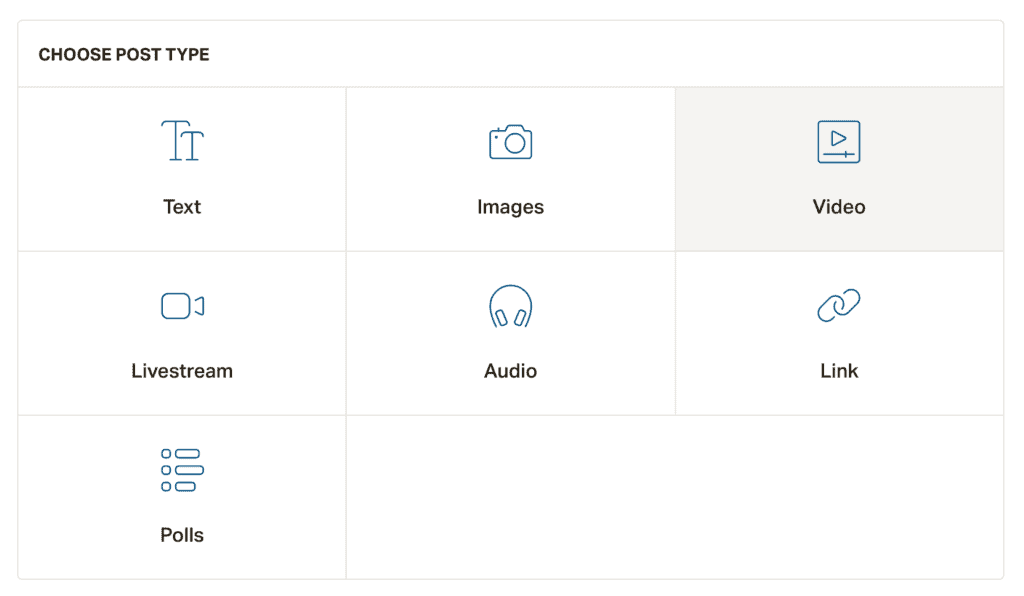
Each of these content types is scalable. You create them once, but they could make 1 person happy, 100 or even 10,000.
The majority of your first three tiers should only contain scalable perks that can be delivered via these seven content types.
Anything, that isn’t scalable, and by that I mean anything that's created for just one paying member only, should be place into tier 4 and above.
Create Premium, High-Quality Gated Content That’s Exclusively Available for Your Patreon Subscribers.
There are many amazing membership perks that you can provide for your audience. In fact, I have written a compilation of the top 100 perks for any membership website.
But by far the best perk is high-quality, premium content, such as a workbook, e-book, online course, etc. that people otherwise had to pay for.
To make this scalable, you have to take your premium content upgrade into consideration, when you plan out your videos themselves.
As an example, remember the compilation of the top 100 membership perks, I just mentioned? You can get this for free when you join me on Patreon.
Now, I am fairly certain, that this is a very attractive offer to you. How do I know that? Because it's closely related to the article you're just reading.
Here is how you can plan your own premium content upgrades.
Think of your next video as a puzzle. And your content upgrade as the piece that nobody knew it was missing, until you pointed it out to them. Suddenly, there is this big gap, that everyone wants to fill.
Here are seven easy ways to create premium content upgrade for your next video:
- Create a list of everything that went into the research of your video. Articles, videos, podcasts, books, interviews, etc. Compile everything into a beautiful PDF document. People who want to go more in depth will love it!
- Create a worksheet with fill in the blank exercises that your viewers can print out at home.
- If your video is a digital tutorial, consider uploading the project files or the final results for those who want to play with your material at home. This also works great for games. Think of saved games or digital assets, etc.
- Record a complimentary video with homework and exercises for people who want to go into more depth.
- Create a transcript of your video and compile it into an e-book.
- Convert your YouTube video into an audio file that people can listen to on their smartphone.
- Create a Q&A livestream or webinar for each video where your Patrons can ask you questions.
Also, check out my article with 360+ member-only benefit and reward ideas for your Patreon page.
Turn Your Patreon Homepage Into a High-Converting Sales Page.
In order for someone to become a paying member on Patreon, they have to visit your Patreon homepage first.
There are four sections of your Patreon page that deserve your attention.
- Header and photo. Make sure that these match with your YouTube design so people recognize that this is in fact the right Patreon page.
- The design of your membership tier selection panel. Make sure to add images to all of your tiers to make them stand out. Explain all benefits in detail to make them as appealing as possible.
- Record a dedicated video for your About section and explain to your viewers who you are, why you create videos, how their contribution will help you to do what you do and what benefits paying members will receive.
- For the recent posts section, make sure to always give your Patreon only content interesting headlines. They not only serve your paying members but also as teasers for potential future members. And if you're starting a new Patreon page make sure that you post content, even if have no paying members. Potential members will scroll through the list of recent posts to get an idea of what kind of content you're posting and if it's empty they will be reluctant to join.
Promote Your Patreon Page on YouTube.
There are 5 ways how you can promote your Patreon page.
- Put your link in your video description.
- Create a pinned comment and link it to your Patreon homepage.
- Add your Patreon link to your channel about section and pin it.
- Create an overlay with your Patreon page URL and include it in all of your videos.
- Verbally mention your Patreon page in your video and explain people who they can access your Patreon page.
Promote Your Gated Premium Content on Patreon.
High-quality premium content upgrades are best promoted on specific YouTube videos themselves.
Plan and write your YouTube script and content upgrade first. Then determine when and how you want to promote your content upgrade in the video itself.
Think about the promotion as a hero's journey. Your video is giving your viewers everything they need to defeat the dragon, armor, sword and guidance. And your content upgrade is the nice to have, but not strictly necessary add-on, that makes life that much easier, like an unbreakable shield.
Nobody thought, they would need it, but the moment you explain its benefits, people suddenly feel incomplete and want to have it.
Now all you have to do is to explain to your audience how they can access it.
Conclusion
Patreon is an amazing platform. And with the right strategies and tactics it can become a major pillar of your content creator income.
In summary
- Understand your audience and tailor your offering to their needs.
- Structure your pricing to get the highest possible average monthly spend from all members.
- Always focus on scalability. There is no point in creating a Patreon page, only to burn out after a couple of months.
- Create premium content upgrades and promote them in your videos.
- Optimize your Patreon homepage to maximize conversion rates.