In this article, I'll explore with you why people share YouTube videos and other content on social media or via direct messages.
Once you have a clear understanding of why people share, you can use this information in the next section to plan your videos for maximum shareability.
This will allow you to maximize your video views, boost your watch time, and get more YouTube subscribers fast.
Are you excited? I sure am, so let's jump right into it! 😉
What Your Viewers Care About
There are five spheres of influence that you have to consider when it comes to sharing any form of content on the web.
- I
- Family
- Friends
- Work
- World
Whenever you share something online, it will always impact or touch one of these five spheres.
The following list contains the most common motivations why people share, and how they touch different aspects of the five spheres.
They Want to Feel Good About Themselves
Ask yourself... Do you enjoy reading your comment section or receiving private messages from friends and fans who thank you, because you always share and sent great information their way?
Does it make you feel good about yourself? Do you feel valuable and needed?
And yes, we all feel this way from time to time and in varying degrees.
If you can convey this idea to your audience, that if they shared your video with their family, friends, and co-workers...
They could feel amazing, valued and appreciated, because everyone would be super excited and thank them for sharing so much knowledge and entertainment (your video) with them...
You will see that the number of your shares, and as a consequence "external traffic" to your YouTube videos will skyrocket.
They Want to Convey How They Feel
Sometimes a video has just the right message and vibe at the right time, that people naturally want to share it.
This happens if a video is a perfect reflection of how they currently feel, or where they want to go, how they want to feel, what they want to do, how they want to be.
When something just "clicks" with them!
In that moment, sharing your video becomes a form of self-expression for them and it allows them to associate themselves with whatever is shown in your video.
You can see this phenomenon everywhere, especially on Instagram, when people share motivational success quotes.
How can you take advantage of this? In two ways.
You can pay more attention to how planning the emotional journey of your video. Who do you want to watch your video and what emotions do you want them to feel? And then be more intentional about creating these feelings from planning, filming through editing.
Sometimes it's not possible, to do that with every single video. What you can do instead is to plan for an emotional video every once in a while.
For example, once per month, you could create an inspirational motivational video.
Or you could throw in a personal, emotional story once per week.
You might even start a second YouTube channel that focuses exclusively on vlogging about yourself and your own personal emotional roller coaster in life.
They Want to Remember Something
Sometimes people just share something to remember something.
I know plenty of people who sent me random links via direct message. And when I asked them why, they told me straight that they just wanted to save a link and didn't have a way to bookmark it on the go.
This works best with both educational and entertaining videos.
The key is that something is either so useful (or funny) for the viewer him or herself, that they want to watch it again later when they're free and have more time, or they know someone who might benefit from learning from you, but they don't have their contact information at hand.
When you create your videos, think about the specific value of your video both in terms of knowledge/usefulness and fun/entertainment.
They Want to Understand Something
Did you ever read an interesting article, only to leave confused by the end of it?
Sometimes when we're unfamiliar with a specific topic, nothing seems to make sense.
In these moments, many people will share the content, not because they liked it so much, or because it was so entertaining or educating, but because they don't get it.
They find clarity and make sense of everything by reading what other people (who might know more about something, than themselves) in the comments.
The best way to appeal to this motivation is by creating controversial videos with unfamiliar explanations and answers.
They Want to Be the First
We all have this one friend who always knows everything, and is always the first one to tell everyone about anything new.
If you have the same personality trait, you probably take tremendous pride in the fact, that you're always at the cutting edge of knowledge and wisdom.
These people see themselves as pioneers. They always have the latest tech gadget, waited two days in line to get their hands on the first-ever iPhone, and are always online, following all the latest trends and news channels.
If you want to get this personality type to share your videos, you have to be at the cutting edge too. Both in terms of the content that you produce and your production time. There is no point in being the first to know something, you have to be the first one to publish about it.
If you can do this, you can be certain, that your channel becomes a magnet for trendsetters and hipsters who are using your videos as a valuable resource to learn about the latest trends and discoveries, so they can take what they learned from you and tell it to their friends to impress them!
They Have a Big Aha Moment
When was the last time that you had a big aha moment, on the magnitude of discovering, for the first time, that if you touch the hot stove in your mum's kitchen, that it causes pain?
Big discoveries lead to big impacts and fill us with feelings of awe and wonder.
If you can create these feelings within the viewers of your videos, you will see an explosion in shares!
Show them something that they didn't suspect, tell them something unforeseeable surprising, introduce them to a big secret that nobody knows about, show them how something works in the inside or behind the scenes and you're in good shape to get a ton of people to share your content everywhere!
They Experienced an Emotional Transformation
Having an aha moment is a wonderful feeling.
What's even better is to experience an emotional transformation!
Wait... what are you talking about Tim?
Glad you ask, let me explain.
Think of the most boring task you can think of at school, university or at work. Something that's super boring and repetitive that you have to do for prolonged periods of time.
Let's call this your baseline emotional state. You can imagine this as a flat line.
If anything goes up, you experience joy. If anything goes down, you experience pain.
Whatever happens, everything will eventually come back to baseline.
How intense ANY emotional experience in the history of mankind is, depends on how far the emotion travels on the y-axis!
Y-axis?! 😢 Are we talking about math now?
Just a bit. Bear with me, ok? It'll all make sense in a moment.
Let's say you have a good start into the day and someone keeps the elevator door open for you (+1 happiness). Everything seems to be going well for you until someone bumps into you and you spill your coffee all over your shoes. (-2 sad & disappointed).
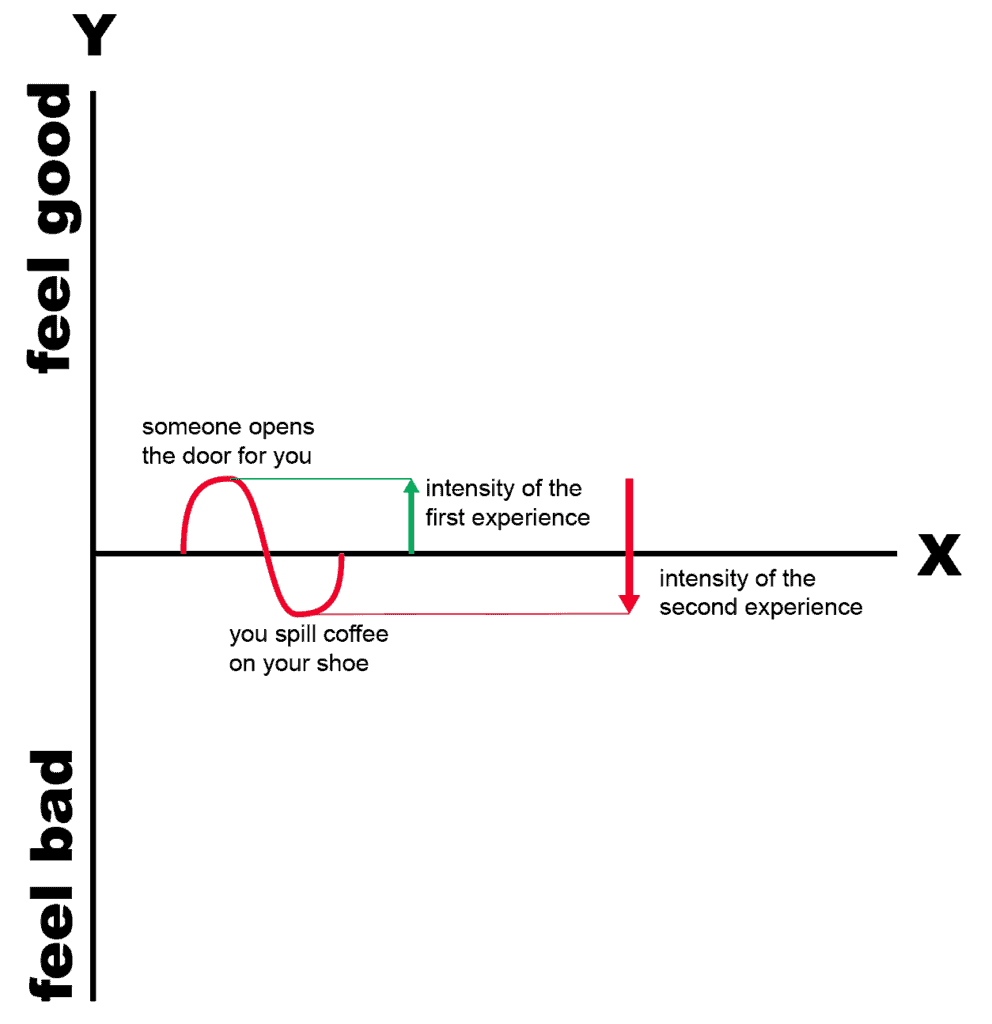
You see, what's happening is, we experience all of our emotions as a rolling average. Whatever we feel in this timeframe becomes our new baseline.
If you're a super-rich billionaire, who has EVERYTHING, would you jump out in joy if someone gave you another iPhone for your birthday, even though you already have 11 others? Probably not, this person's baseline has shifted.
If you're depressed all the time, do you care that much if someone didn't open the elevator door for you? Whatever... Don't care.
BUT, if you can create a good emotion first, that's quickly followed by negative emotion, the second emotion will feel more intense.
That's called emotional anchoring. The first emotional experience shifts your baseline and anchors it as your temporary normal. The second emotional experience is then measured against the new baseline and as a consequence feels much more intense.
Now, congratulations. I just taught you everything you need to create the next Hollywood blockbuster! 🙂
But let's get back to your YouTube videos. Now that you understand the concept of emotional anchoring, you can create ANY emotion on ANY intensity level, simply by structuring the sequence of emotional experiences.
Now you just have to add the absolute values (minus becomes plus) of each experience to calculate the total emotional experience of your video.
Our previous example would have a value of 3 (1 up + 2 down).
The bigger the number, the more intense the emotional experience, the higher the probability that someone wants to share your videos.
They Want to Share Positive Emotions
Some videos are just pure entertainment. I'm talking about fun stuff like this...
They spark joy, as Marie Kondo would say! 😍🤩
Hey!!! You can stop watching the video now, it was just for illustrative purposes! 😜
It turns out that laughing is good for a lot of things, including improving both your mental and overall health.
And as the saying goes, sharing is caring. Or shared laughter is twice the fun.
If your channel is all about upbeat, feel-good, and funny videos, you're in luck because many people want to naturally share these with their family, friends, and co-workers.
People who share these videos want to enrich the lives of those around them and experience positivity and happiness with the people who are most important to them.
They Want to Share Knowledge
People love to share knowledge and information with others. It allows them to inform others about things they care about and potentially change their opinion on something or encourage them to take action.
You can use that to your advantage by carefully planning out your next video.
Think about who will watch your videos? And who do they, your viewers, know who might benefit from this information.
You will often find that birds of the same feathers stick together. The same is true for any profession. We tend to become friends with those we spend the majority of our time with.
If you make videos for artists, chances are good that one artist knows at least 10 other artists.
It doesn't always have to be the same field. Sometimes, people in one field have to deal with people in another field on a daily basis. Think of wedding planners, they sure know a few florists, photographers, videographers, and food delivery businesses.
The key to having success with this method is to create an overlap in the topic. Make a video about something your viewer cares about AND something that one of the people they spend a lot of time with cares about.
Carefully consider how the information they share will be useful to the recipient.
Then make sure that you verbally mention it a couple of times in your video, so your viewers can tell themselves, "yes, great idea. I should share this with my friend who is doing..."
They Want to Grow and Nourish Relationships
I like to call these people connectors. They thrive and bloom when they build and strengthen relationships with those around them.
Sharing videos and articles is a form of communication that allows them to stay connected with those people in their life, those they may not otherwise stay in touch with.
If they send you a link to a funny video, it's their subtle way of saying: I'm here. I'm thinking about you. Let's have a chat soon.
Most connectors are very thoughtful when it comes to what they share with who. They always take the recipients' interests into consideration.
You can encourage connectors to share your videos by highlighting, how the content of your video might be able to help one of their friends in a specific scenario. If they happen to have such a friend, it will be a welcome reminder to show them how much they care about them.
They Want to Help Others
Very related to the connector is the altruistic sharer. They care about other people deeply and are trying to help in as many ways as possible.
If they know someone who is currently in a challenging situation, and your video pops up in their newsfeed, they might just watch it in hopes of being able to help one of their friends, even though they might not be interested in the topic of your video themselves.
Generally speaking, any videos in how-to categories, especially those that talk about solving very challenging situations, have a high probability of attracting altruistic sharers, who are always thinking about new way how they can support the people around them.
They Want to Make Friends
How do you make new friends?
For most people the answer will be somewhere between spending time with someone, talking and communicating, and performing little acts of kindness, not necessarily in that order.
One of the easiest ways of building and strengthening a new friendship is by doing small favors for your newfound friend. This can be listening and talking to someone. Or sharing something valuable, useful, or entertaining with that person.
Taking small actions on a consistent basis creates positive emotions and demonstrates to the other person that you care about them.
All you have to do is to remind your viewers how your video might be able to provide value to one of their friends, or even just to create a smile on their face.
They Want to Find a Romantic Relationship
How do you find true love?
By sharing YouTube videos!
Well, it would be nice if it was that easy. But sharing videos can be an amazing tool when it comes to building a romantic relationship.
For once, it's an efficient way for the sharer to communicate who they are and what they care about. As an example, sharing a funny video allows person A to demonstrate their sense of humor, and it allows person B, the recipient, to understand if their humor is compatible.
If you want to turn your YouTube videos into Cupid's best friends, create content on the lighthearted side of life.
Funny, light-hearted content that's entertaining and interesting how-to videos for potential couple activities such as watching movies, cooking, sightseeing, and traveling are great places to start.
They Want to Gain Someone's Favor
Sometimes people don't really care about your content.
They just share them as a means to an end. In this case, to gain someone's favor, by demonstrating, or pretending to be interested in the same topic, as the person they're trying to influence.
There is no need to appeal to this form of motivation, as it's just an extension of what they believe, someone else would want to see.
They Want to Elevate Their Career
You will often find a very similar behavior among career-driven people.
They will share articles and videos, preferably on LinkedIn, in an effort to look smart and competent to impress their boss.
You can motivate this personality type by choosing your video topics carefully. Anything that has the vibe of "make more money", "increase the productivity of your sales force", or "how to maximize customer satisfaction" is a good starting point.
This works great for business-focused channels, especially for those who have an audience that in the corporate and B2B space.
You can maximize the number of shares in this group by crafting catchy video titles that promise specific results, without being too over the top.
They Want to Build a Personal Brand
To some people sharing is a form of self-expression. They carefully pick and chose videos and articles as a means of defining themselves to others.
They try to share information that will reinforce a specific image they'd like to present and to give people a better sense of who they are and what they care about.
What does sharing this video say about me? What will someone think about me, when they see the title of the video I shared? Is this in alignment with my personal brand?
You can motivate this group of people to share your video by talking about aspirational themes and topics in your videos.
Focus more on why questions, rather than how-to guides, as those who focus on building a personal brand, often want to be perceived as the go-to person who has all the answers of how to do something.
They Want to Brag, Flex or Show-off
When personal branding on steroids, narcissism, and low self-esteem meet, you get an interesting personality mix.
Many people who share these three personality traits tend to constantly brag, boast, flex, and show off whenever they can.
There are two main forms of flexing.
The unapologetic type, who just says it how it is. "Just bought myself a brand-new $100k Rolex watch".
And then there is the humble bragger. They brag more indirectly, instead of being explicit, they find a way to boast indirectly, ideally in a way that makes them look humble. Caption: "Just surprised the local soup kitchen with a delivery of groceries." Photo: Lamborghini selfie in front of the local charity shop.
Normally these people will only ever share content about themselves, with two expectations.
If you praise them in one of your videos, they will share it. They just love it, when others talk about them in a positive manner.
If you're a much bigger influencer than themselves, they will share your content. They hope that you will notice them and that they then can exploit the relationship to their own benefit.
My personal recommendation is to stay away from them as far as possible, as this personality is one of the most toxic types on social media.
They Want to Get the Word Out About a Cause
When people deeply care for a cause or something greater than themselves, they transform from shy lurkers to a vivid sharers.
They want to make an impact on the world and create change by taking action. Waiting for things to sort themselves doesn't exist in their vocabulary.
You can attract this type of sharer by creating videos that are in alignment with the goals of their favorite cause. This could be sharing results and research that confirms their suspicions. It could be sharing your opinion about an important issue that is strengthening their belief. It could be sharing news about real-life events that put a smile on their face.
Or it could be the complete opposite. You could share research or opinions that contradict their beliefs, and they might share this with members of their cause in an effort to debunk you. Bad news is another reason to share, there is something that must be done about it!
They Want to Manipulate Public Opinion
Not everyone's motives are pure when it comes to sharing videos and articles online.
Some people just can't take it when other people have a different opinion from themselves and try to do something about it.
They will share a wide variety of content, in an effort to manipulate the people around them, to come around to their beliefs.
They can be super blunt and direct and share obnoxious clickbait headlines, or they can be very subtle and share legitimate-looking, fake news and propaganda channels.
Sometimes this type might purposefully twist a creator's words. They might share someone's video, and then pretend that the content is supporting their belief, by writing a misleading headline. Knowing that many people will only read the headline, but never fact-check by watching the full video.
Be mindful about this type of sharer, especially if your channel deals with sensitive topics, and try to avoid ambiguity in your video titles, that might be twisted and put in a different light by someone devious.
They Want to Confirm Group Identity
Sharing isn't always about changing other people's minds. Often it's about affirming the beliefs of oneself and the group.
Imagine that you're part of a group. This group might pursue a noble cause, share a common belief or faith, or follow a political goal.
Most groups naturally attract opposing forces who try to convince your members to change theirs.
To protect against that, most groups will frequently share content inside their own group to strengthen everyone's beliefs and resilience against outside forces.
Unless these kind of groups are your thing, you wouldn't come across many of these types of sharers.
If your goal is to attract them, here is what you can do with your content: Create debunking videos of the other groups' beliefs or arguments.
They Want to Create Conflict
Some people just want to see the world burn. Or at least ravel up everyone's emotions in a comment thread.
They take pleasure from agitating other people and causing intense emotional reactions.
This type goes by many names, but the most common label is trolls.
They share videos to create conflict.
For example, they might share a YouTube video about how to cook the perfect steak in the comment section of a vegan blog.
To make your videos less attractive for trolls, focus on keeping your video titles less controversial and clickbaity.
The Secret Behind Creating Share-worthy Videos
When you learn to truly get who your audience is, know their every need and desire, and understand their motivation for sharing content with their family, friends, and co-workers, you're able to create share-worthy videos that your audience will love on a consistent basis.
Being able to get your audience to share your videos is one of the most powerful growth factors when it comes to growing a YouTube channel. One which will quickly be rewarded by the YouTube algorithm with extended organic reaches among new audiences who have never heard about your channel.
If you want to learn how to quickly grow a small YouTube channel, check out my article about how to get more people to share your YouTube videos on social media.
Also interesting, how to get more subscribers, how to get more YouTube views, how to boost your video click-through rate, and how to design thumbnails that your audience loves.
You can also check out my TubeBuddy review, where I share how I used this incredible YouTube growth tool to get my channel from 0 to 3,000 subscribers.