The History of User-Generated Content on LinkedIn
Before 2020, LinkedIn was a paradise for anyone who understood how to create interesting, premium-quality content.
During this golden age, content creators were able to generate millions of views with their LinkedIn posts.
All of this was possible because of an experiment that LinkedIn had rolled out across its entire platform...
At the time. LinkedIn noticed a huge problem. People were seeing LinkedIn only as a CV database.
Instead of logging into their LinkedIn account daily, they were using other social media networks such as Facebook and Twitter on a daily basis to communicate with each other and to share articles and news.
Users only accessed and updated their LinkedIn account during job transitions or to check their inbox when recruiters sent them messages.
This had a direct impact on LinkedIn's revenue.
A low number of monthly active users meant, that LinkedIn could only sell a limited amount of LinkedIn Ads and LinkedIn Premium subscriptions.
The solution?
User-generated content to get more people to login and engage more frequently!
Types of organic content on LinkedIn
External links
In the early days of LinkedIn, the only content type available was sharing of external links.
Early pioneers realized the enormous potential of this feature and used LinkedIn as one of their top sources to generate inbound traffic for their blogs and articles.
LinkedIn wouldn't stop there.
Slideshare
Over the years it acquired and developed many different companies and technologies to enhance their own platform and to make it more attractive to users.
In 2012, LinkedIn acquired SlideShare, an online platform that allowed to share PowerPoint presentations and slide shows online, and integrated it into the LinkedIn platform.
As competition with other social media networks grew, more and more social media platforms attempted to keep their users on their own platform by introducing more and more native content types.
LinkedIn articles (AKA. LinkedIn pulse)
LinkedIn jumped onto this trend with the creation of LinkedIn articles.
Instead of sending people away from LinkedIn to read an article on someone else's website, readers could now read articles on LinkedIn itself.
In the beginning, LinkedIn articles were limited to LinkedIn Influencers with the blue badge. Later, LinkedIn rolled out LinkedIn articles to everyone.
LinkedIn posts
What was missing was a newsfeed comparable to Twitter or Facebook.
This all changed with the introduction of LinkedIn posts.
LinkedIn referred to these content types initially as shares or status updates but settled for posts in the end.
Both LinkedIn text-only and photo posts were limited to 1,300 characters of text.
Unlike articles, it was impossible to use different fonts and styles. It was just pure text.
Photo posts were essentially a regular text-only post with an attached photo.
LinkedIn stories
(Update: LinkedIn retired LinkedIn Stories after 30 September 2021 and this feature no longer exists today.)
Recently, LinkedIn introduced LinkedIn Stories to its content mix. Short vertical videos of up 20-seconds in length or photographs with or without text overlays and stickers were a welcome addition to the LinkedIn platform.
LinkedIn algorithm changes
For a long time, these LinkedIn posts didn't have a huge amount of reach. Content was usually only seen by first-level connections and rarely went viral.
This changed in 2017, with the introduction of a new LinkedIn newsfeed algorithm that attempted to show readers more relevant and interesting content in their newsfeed based on interests and preferences.
I was one of the early adopters and quickly learned how to utilize the new newsfeed algorithm to generate leads on LinkedIn with content marketing.
My biggest post generated over 3.5 million views, I had several posts with 500,000+ views, many with 100,000+ views and almost all posts had a minimum of 10,000 to 50,000 views.
It was the golden age of organic reach on LinkedIn.
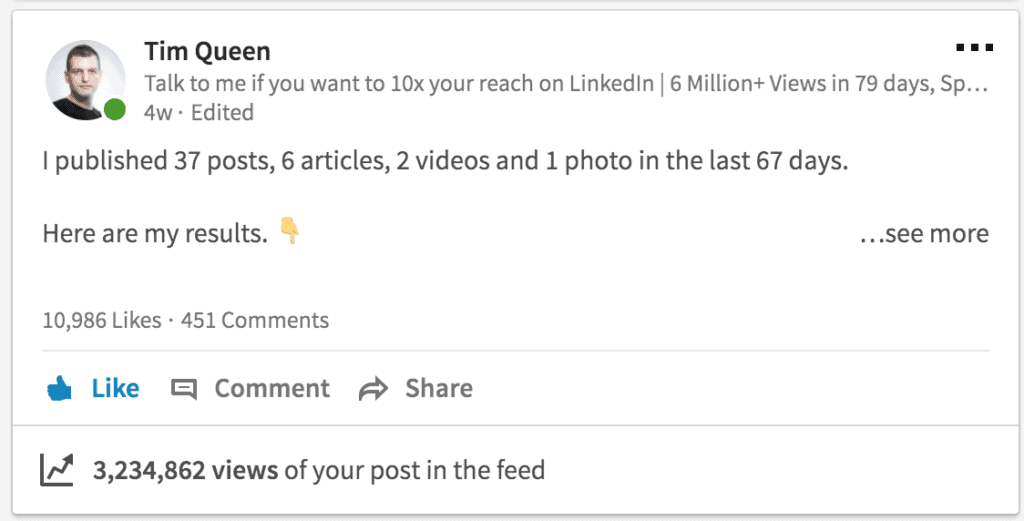
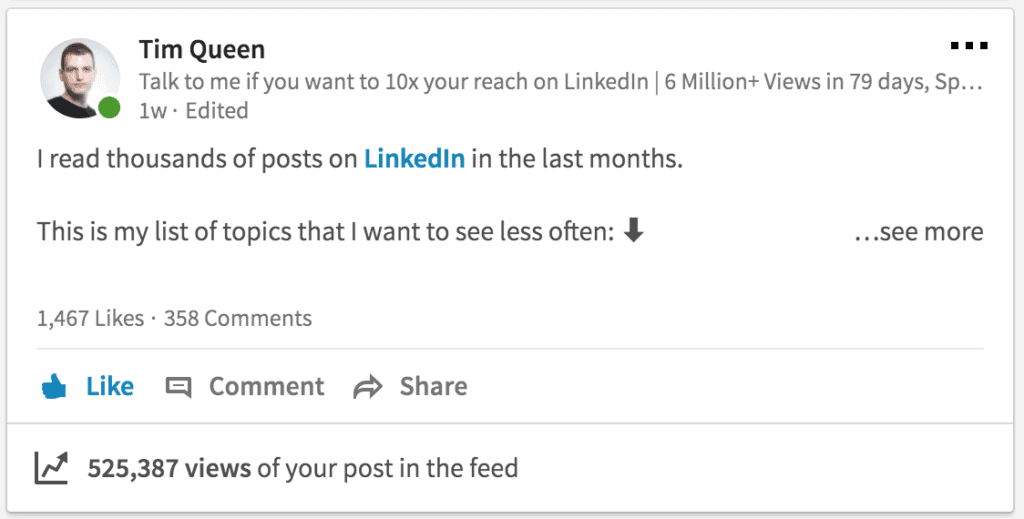
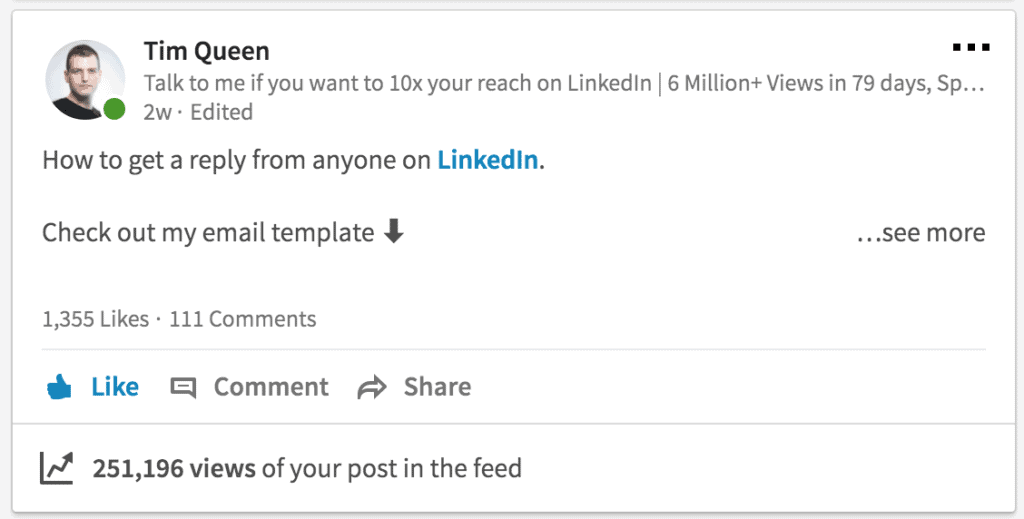
As time went on and LinkedIn introduced more and more native content formats. First video posts, then document posts, then live-streaming.
Every time they would tweak their newsfeed algorithm to give the cool new content type a massive, unfair advantage when it came to newsfeed impressions.
With the introduction of video posts, text posts were downranked and lost a huge number of impressions. If you wanted to succeed you had to ride the wave and switch from text to videos.
This all changed in late 2019, early 2020. If you want to learn more about the earlier algorithm changes, check out my other article: LinkedIn Algorithm Changes Explained.
Today, the organic reach on LinkedIn is much more balanced and it's more challenging to go viral on LinkedIn.
If you need a dose of content inspiration to attract your ideal clients on LinkedIn, check out my article: Best Content Ideas for LinkedIn.
How Did LinkedIn Limit the Organic Reach?
The organic reach of all user-generated content on LinkedIn was dramatically reduced in favor of other content types.
Re-prioritization of content types
On a technical level, LinkedIn achieved this by re-prioritizing different content types such as LinkedIn ads within their newsfeed.
Today there isn't any obvious favoritism when it comes to content types such as text-only, photos, video or documents. All have been downgraded globally and are now much less effective.
Higher engagement-rate thresholds
In the beginning, you could write a post, and if one of your connections or followers would like it (your 1st level), it would be shown to all of their connections and followers (your 2nd level).
If a connection or follower of a 2nd level connection would engage with the post, it would be shown to all of their connections and followers too (your 3rd level).
Nowadays, your content will almost always only be seen by your first-level connections and direct followers.
Engagement-quality requirements
You now need much more likes, reactions, comments, and shares in order for it to spread.
It is still possible to go viral on LinkedIn, but you need a lot more engagement to make it happen.
You also require a higher level of engagement-quality such as longer and more in-depth comments, comments on comments chains and sub-comment threads. As well as shares with descriptions.
Engagement velocity trigger
The engagement velocity is also more important.
If you don't get initial engagement for your post fast enough, your content won't spread.
This has nothing to do with the quality of your content and more with the time of posting plus a little bit of luck that your post was shown to just the right people in this short time frame.
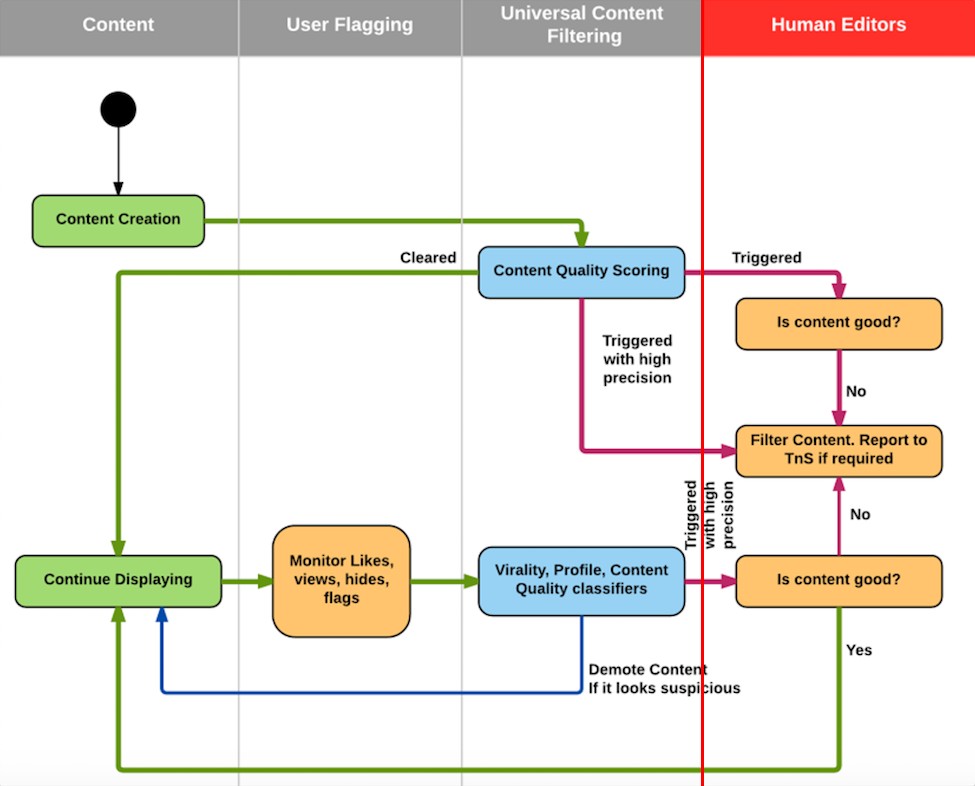
Manual content review process
It is also worth noting that your content only can grow to a certain undisclosed view count. Afterward, it will be put on hold by the LinkedIn newsfeed algorithm for manual content review by a LinkedIn editor.
Only if your post is in alignment with LinkedIn’s internal, content guidelines will it be allowed to go grow further or even go viral.
If it’s not, it’s organic reach will slowly die after the review. The entire process isn't transparent and we know almost nothing about LinkedIn's internal content guidelines.
All we know is that it has become a lot stricter.
Prioritization of blue-badge LinkedIn influencers
On top of all of these changes, LinkedIn makes it a lot more difficult for content creators to grow.
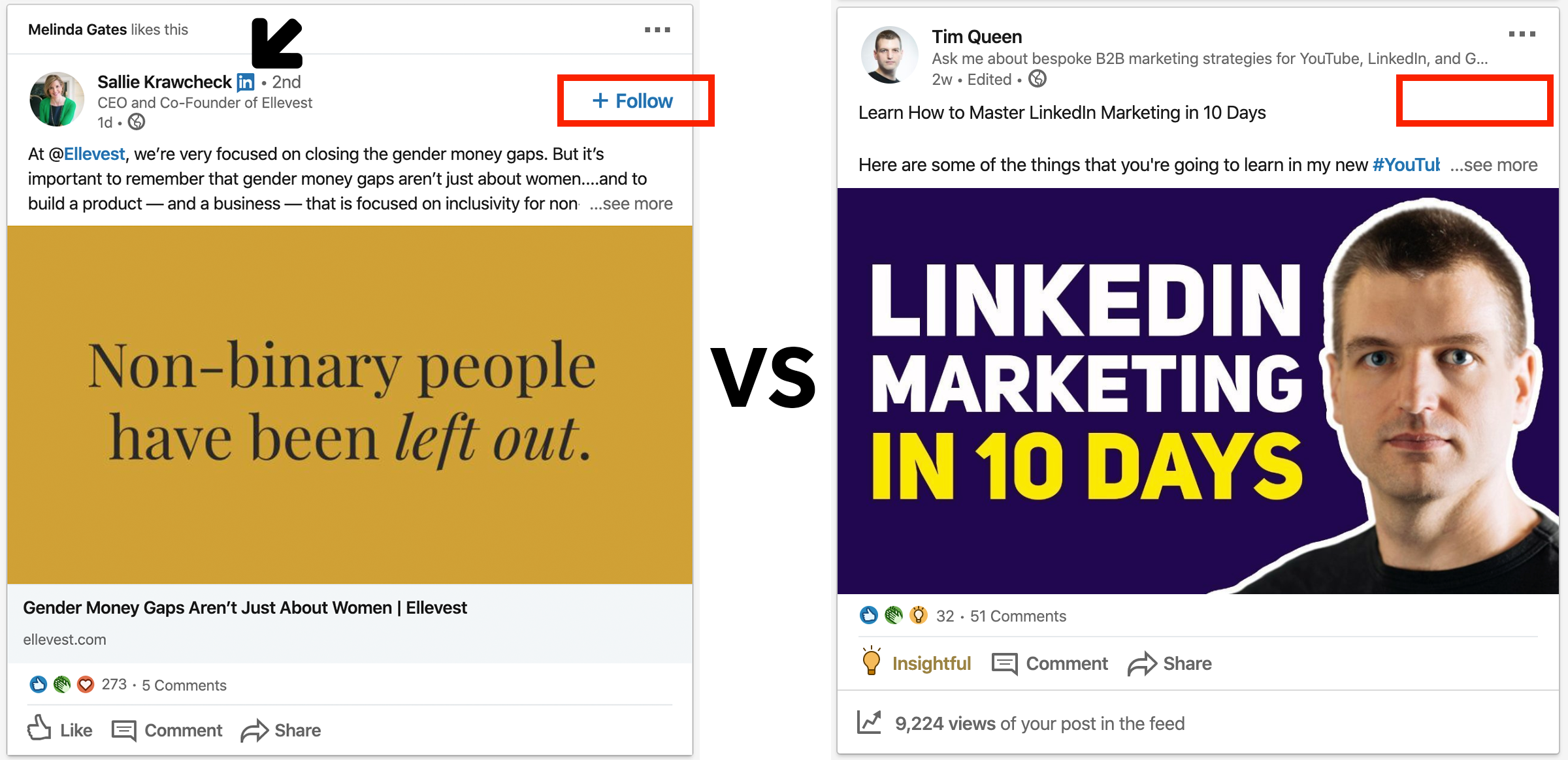
First, they removed the follower count from posts, then they removed the follow button from everyone, except official LinkedIn influencers.
Today, an interested reader has to click on someone's profile and follow them. This decreases everyone's growth in terms of followers on the entire LinkedIn platform.
Why Is LinkedIn Doing This?
Declining LinkedIn ads revenue
LinkedIn realized that many companies weren’t willing to pay for expensive LinkedIn ads anymore.
Because... Why would they, if everyone could get millions of organic views completely for free?
That was a huge problem for LinkedIn.
In 2016, ads accounted for 18% of LinkedIn's total revenue. Fewer ads meant less revenue for LinkedIn, so they turned back the wheel.
Growing popularity among content-creators
Another reason is, that as more and more content creators joined in on the LinkedIn hype and took advantage of the incredible organic reach.
The result?
The overall content-quality went down and LinkedIn users started to complain.
This posed a huge risk for LinkedIn.
If LinkedIn couldn't keep their members entertained, they would log into LinkedIn less often.
And as a consequence, ads-revenue and Premium subscriptions once again would go down.
Audience content-type preferences
LinkedIn also noticed that some of the new content formats weren't as well-received by the majority of LinkedIn users, as they have been on other platforms.
This is specifically true for LinkedIn videos that took up huge amounts of available screen space.
How Are People Coping With It? (Not Recommended!)
Some people bust their heads in the sand and pretend it isn't happening. Others sense that something is changing, but they don't know what to do about it.
Both often resign to their fate and continue with the same old strategies that worked in the past, just with fewer results.
Turning to LinkedIn automation tools
As with all things in life, there are always new trends and opportunities popping up left and right along the way.
One of the most popular (and most dangerous!) coping strategies that has been around for a while is called LinkedIn automation.
They stopped focusing on content marketing on LinkedIn altogether and instead focused on direct-response mass-messaging on LinkedIn.
They use special software tools to automate their LinkedIn routines:
- Visit LinkedIn profiles and download their contact information.
- They follow up with automated connection requests and invitation message.
- If someone accepts their invitation, they receive a cascade of automated follow-up messages if someone doesn't respond.
This approach does not work!
It is in fact very dangerous and can get your account banned for life!
Besides the risk to your account (see screenshot below that was shared with me), LinkedIn automation generally has a very low success rate.
The lack of personalization results in little to no response rates from potential leads.
As a consequence, you're burning relationships with people who would have become customers and are wasting a lot of time talking with people who haven't been properly qualified.
LinkedIn engagement pods
Others started focusing on the higher engagement-rate threshold requirements.
Their solution?
Artificially inflating engagement rate of new posts by liking each other's content.
This approach is commonly known as LinkedIn engagement pods.
LinkedIn engagement pods are usually organized in small groups of 5 to 50 people.
They often use tools such as LinkedIn group chat, Facebook Messenger, Telegram Groups, Facebook groups or Slack channels to coordinate engagement with each other's posts in the form of likes and comments.
Engagement pod automation
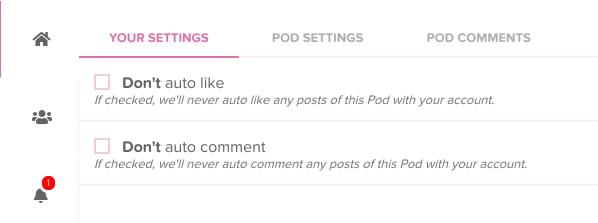
More recently there is an influx of automated tools for LinkedIn engagement pods.
Members have to install a special tool, that automatically engages with other members' content as soon as it is published.
Make no mistake, this puts your account at risk!
Especially when you're using unauthorized automation tools.
Low-quality dilemma of engagement pods
LinkedIn engagement pods are also problematic for another reason.
Think about it this way:
If someone's content isn't good enough to create organic engagement by itself, but then received a huge amount of engagement from an engagement pod...
What will happen next?
This creates, what I like to call, an Engagement Pod Bubble.
All the people within this bubble (= the engagement pod members) will see each other's content. But everyone outside will not!
Engagement pod content rarely travels beyond the boundaries of the engagement pod itself.
Even worse, the LinkedIn newsfeed algorithm will learn that your content only seems to be relevant to other members inside the pod and will rarely show it to other people in your network.
This defeats the intended purpose of the pod and makes it more or less useless.
Reputational risk of joining LinkedIn engagement pods
Engagement pods often pose a huge risk to the reputation of individual members.
All members are required to engage favorably with each others content.
That means that members might be forced to endorse low-quality competitors, fringe opinions and recommendations that are completely wrong and maybe even harmful to their own reputation.
Should You Give Up on LinkedIn?
Now, I know. This all sounds very bad! The old ways don't work. The coping mechanisms such as LinkedIn automation and engagement pods don't work...
So what?
Should you give up on LinkedIn?
Absolutely not!
BUT...
You have to adjust your LinkedIn strategy!
With the recent introduction of the LinkedIn Creator Mode, LinkedIn is reversing many of the changes that made it difficult for content creators. Expect to see the second renaissance when of quality content on LinkedIn.
LinkedIn's Newsfeed Algorithm Priorities
Now you might wonder, how is this even possible? My news feed doesn't look empty! Where did the millions of views go?
Glad that you ask, let me explain... 🧐
Your news feed isn't empty because LinkedIn is pushing different content types out to everyone.
Based on the content that LinkedIn is promoting in their newsfeed, we get a clear idea of their current strategy.
Overall, LinkedIn prioritizes user-generated quality content, for example by professionals, such as journalists, editors, as well as high-profile individuals through the LinkedIn influencer program.
Instead of having LinkedIn members, with unverified skill levels, teaching each other through posts, LinkedIn prefers to push their professional courses via LinkedIn learning from certified LinkedIn Learning instructors.
They also want to get more people to sign up for Premium subscriptions and are heavily promoting them.
It appears as if LinkedIn subtly tries to motivate its members to go back to the basics of one-to-one interactions via chat and messages.
User-generated content seemingly only plays the role of a sidekick and only focuses more on people you actually know. Your teammates, first-level connections and direct followers.
Professional editorial content
Besides curated editorial content, we also see spikes from traditional publishers such as Forbes, National Geographic and The Economist.
These publications see huge amounts of views and engagement with their content, despite technically sharing external links.
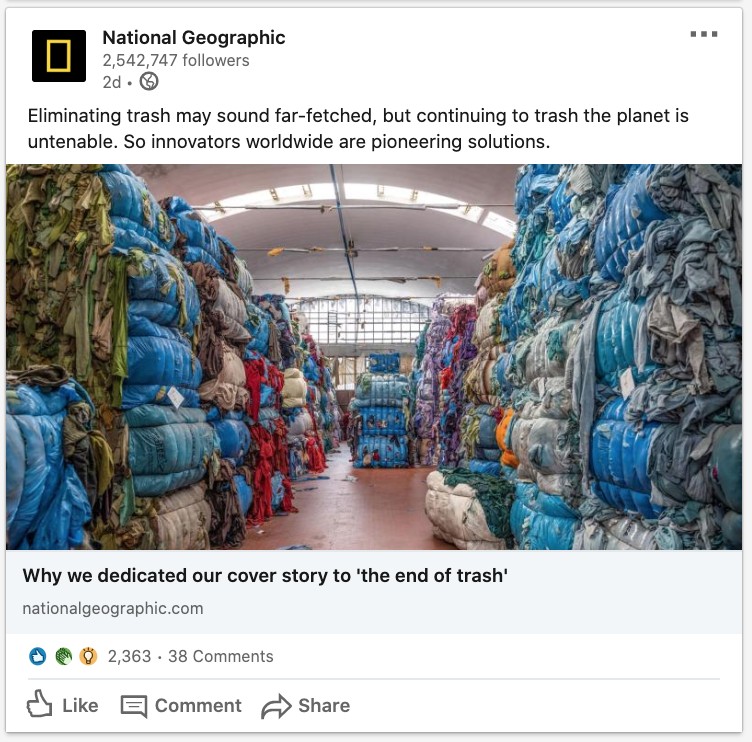
One theory to explain these phenomena is, that LinkedIn might have undisclosed publishing partnerships with individual news organizations. In exchange for payment, LinkedIn might guarantee a certain amount of views and clicks.
Another theory is, that LinkedIn might have whitelisted certain, trusted domains of news organization without compensation. This would give any external links to websites such as Forbes additional news feed impressions over other, unknown domains.
Of course, it is entirely possible that all of this might just be a big coincidence.
In-house editorial content
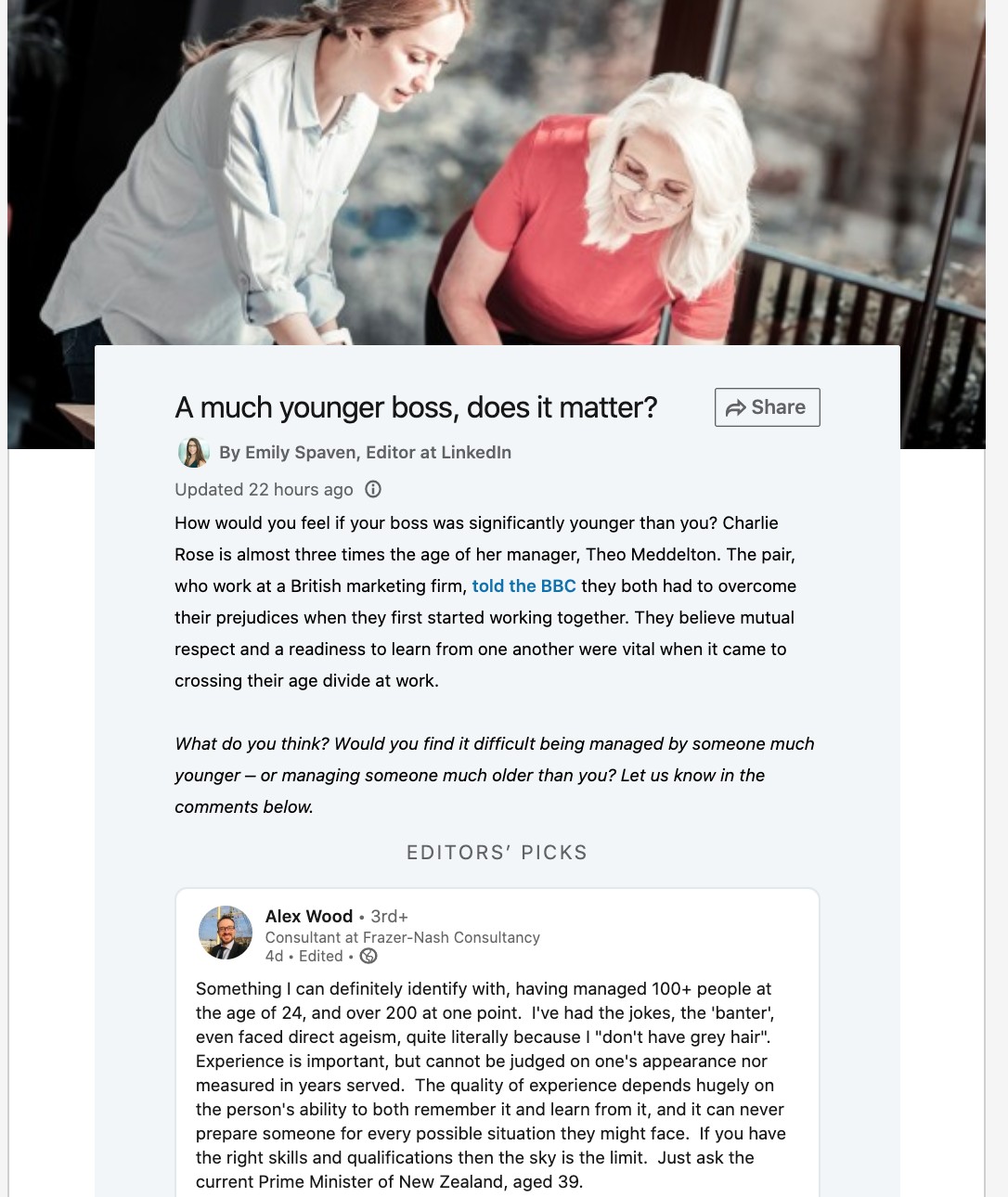
We also see much more internal content from the LinkedIn editorial team about current events and news. LinkedIn has an entire division of LinkedIn editors who are following the news around the world.
Whenever something interesting and significant is happening in the world, they'll create news-of-the-day topics and then share a small selection of hand-picked user-generated content about this topic.
Those selected posts get a huge boost and are shared with more members on the platform.
LinkedIn ads
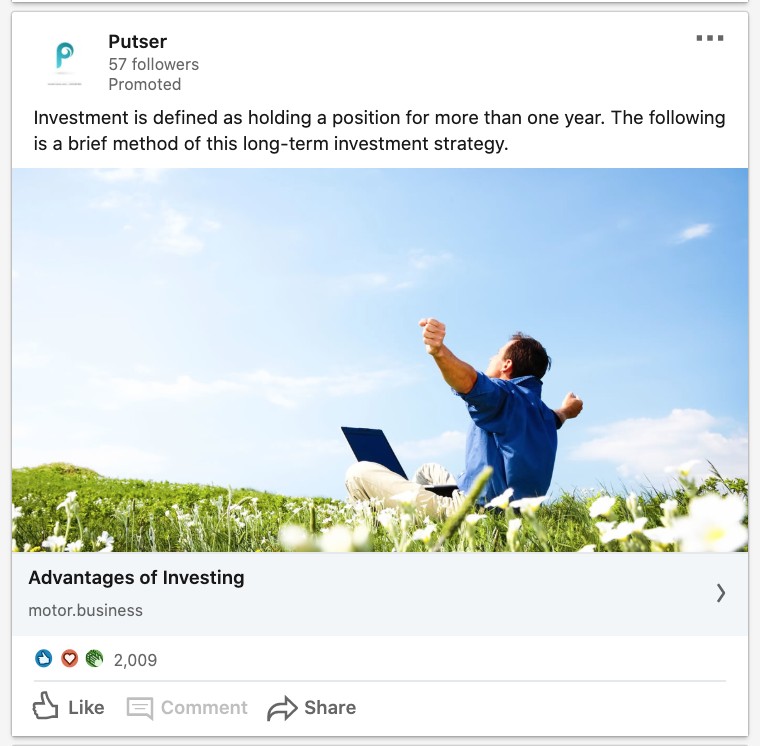
You might have noticed that a lot more LinkedIn Ads are showing up everywhere.
LinkedIn is following in Facebook's footsteps and tries to get businesses to pay, to show up in the newsfeed of LinkedIn members.
LinkedIn products promotion
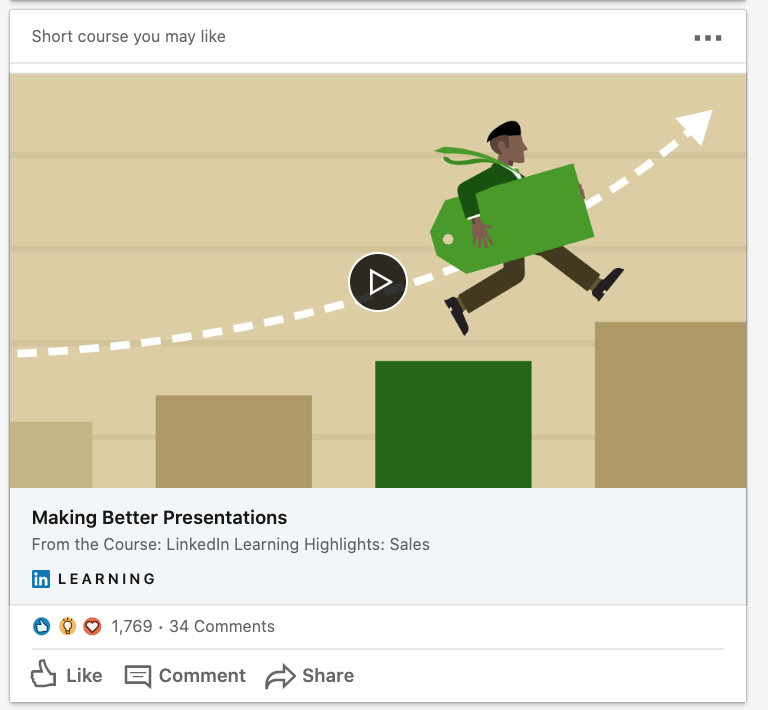
Next, we have internal LinkedIn promotions.
Currently, they are pushing two LinkedIn products: LinkedIn Premium subscriptions and LinkedIn Learning including individual courses.
Content from well-known blue-badge LinkedIn influencers
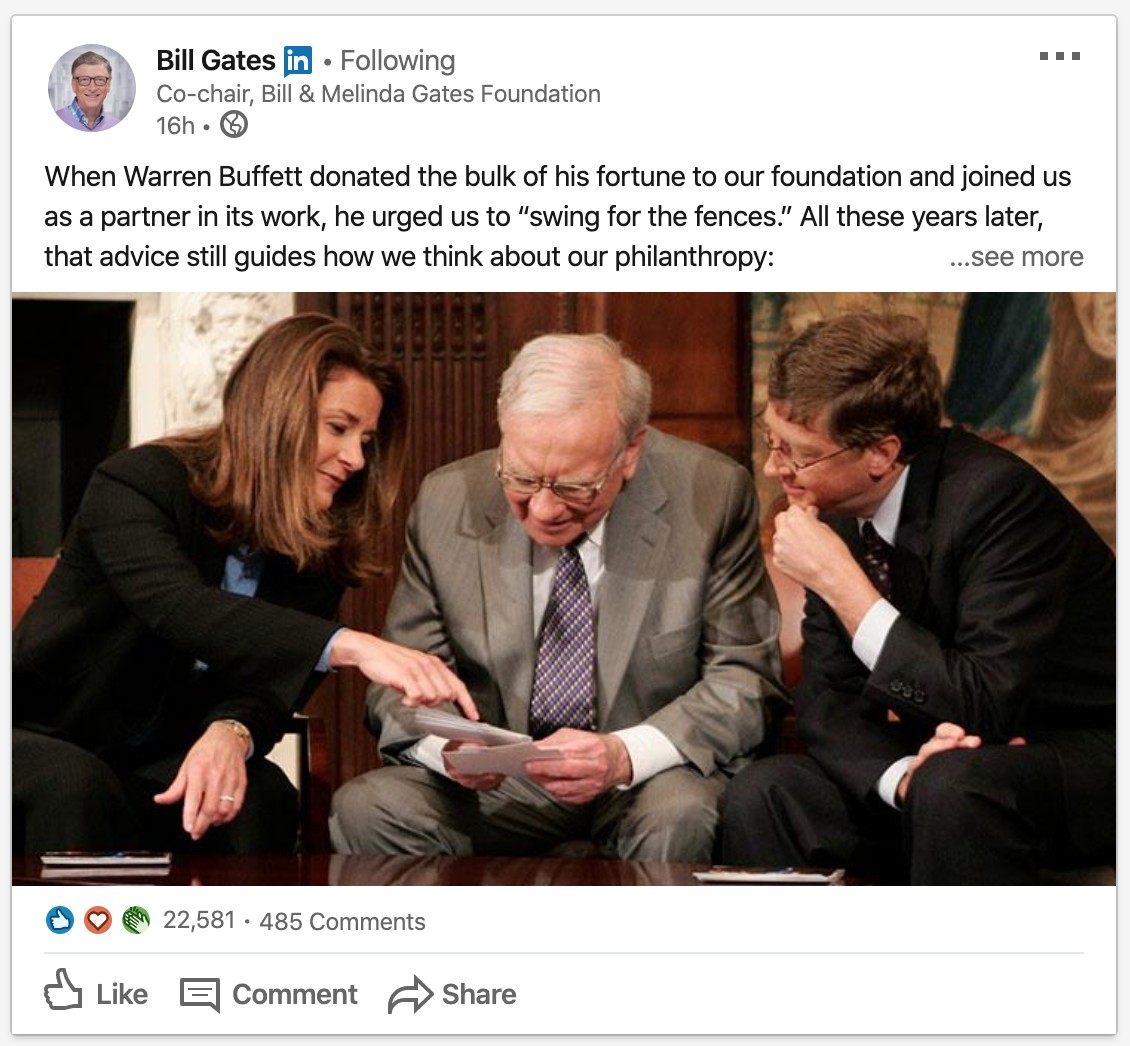
When LinkedIn realized that the overall quality of user-generated content dropped, they decided to re-focus on people they could "trust".
Traditional LinkedIn influencers with blue badges, such as Bill Gates or Jeff Weiner.
User-generated content
And finally, we are back at user-generated content.
Can you still go viral on LinkedIn? Yes!
But it is no longer possible to "guarantee" that a particular post will go viral.
You can still win big with content marketing on LinkedIn though!
Quite easily actually...
If you understand how to create laser-focused content on LinkedIn for your ideal audience, that's optimized for quality engagement and to convert viewers into customers.
Success with this method requires a high degree of sophistication. Mediocracy won’t get you anywhere.
But before you start complaining, consider this:
If it was too easy, everyone would do it!
So by investing your time and energy into mastering this skill, you create a competitive advantage that your competitors can't copy!
What’s Working on LinkedIn?
Sharing external links
External links always had one of the lowest priorities among all content types on LinkedIn.
LinkedIn learned from other platforms such as Facebook and Twitter.
LinkedIn started punishing users for sharing external content so viewers would stay on their own platform longer.
This resulted in more ad impressions and raised overall revenue.
Publishing LinkedIn articles
LinkedIn articles quickly fell out of favor among content creators. The problem?
Writers had no control over their content. They couldn't install any tracking scripts, they couldn't embed any lead generation forms, etc.
So writers started to create gateway articles. They would share maybe the first 10% of their article as LinkedIn article and then link to the full article on their own website.
When LinkedIn realized this, they started to downrank articles and no longer invested in the development of their publishing platform.
Articles have the second-lowest organic reach on LinkedIn after external links.
Yet, they still have their uses! 😉
Creating LinkedIn newsletters
LinkedIn Newsletters are a recent add-on to LinkedIn articles. Members can subscribe to newsletters to receive email notifications when an author publishes a new LinkedIn article. This program is still in beta and by invitation only.
LinkedIn articles and LinkedIn newsletters look identical. The only difference is, that LinkedIn newsletters contain an additional header at the top, above the article headline with a Subscribe button.
Some people had great results, especially with regular, industry news-focused LinkedIn articles.

Sharing native LinkedIn text and photo posts
Text posts were the first native content type that was heavily prioritized by the LinkedIn newsfeed algorithm. It forced content creators to write compelling mini-stories within 1,300 characters of space.
Photo posts had a lower priority since most content creators abused them for low-quality cat photos and memes without any originality.
Together with video posts, they form the backbone of LinkedIn's most popular native content type.
If you can master engagement from your ideal audience, LinkedIn posts will be your new best friend.
Recording native LinkedIn videos
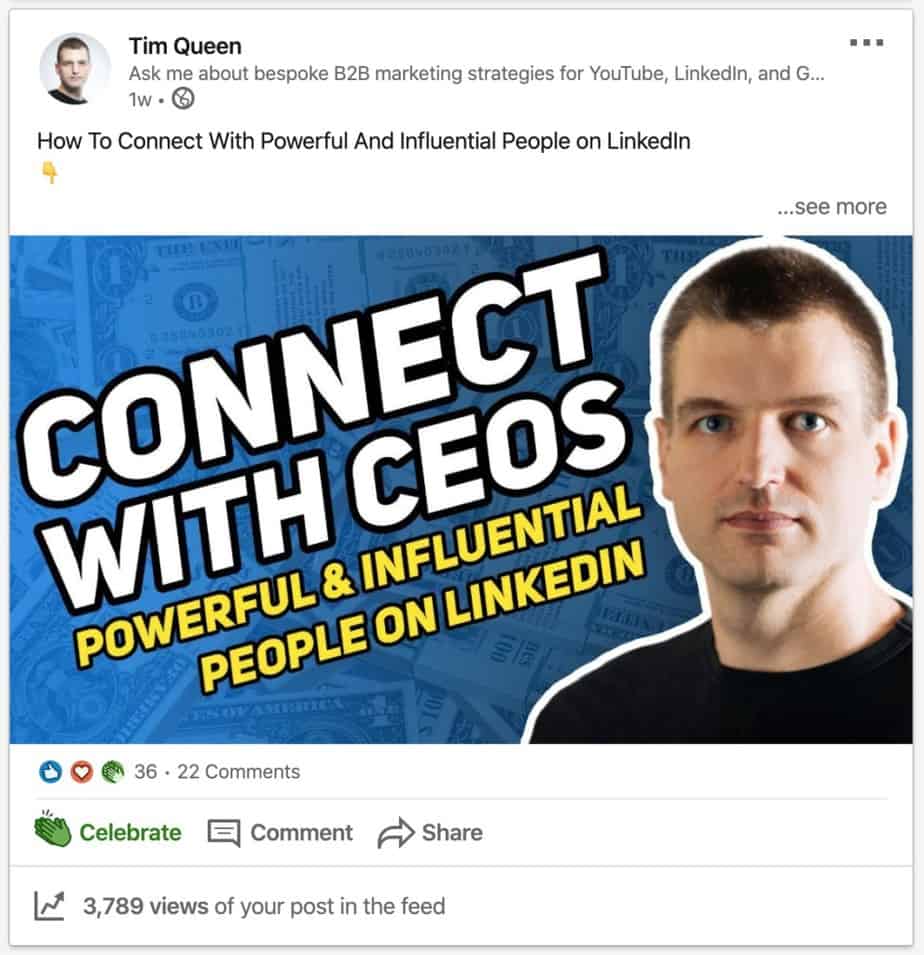
Video and video marketing was a huge buzzword in 2019. Everyone was talking about how video and visual content would take over as the number 1 medium for B2B marketing.
LinkedIn had huge plans with video and aggressively pushed this new content type out to everyone. At that time it was quite easy to generate anywhere between 10,000 and 100,000 views.
As more and more content creators flooded the platform and started to take advantage of it, the average video quality dropped dramatically and people started to complain. That's why LinkedIn decided to de-prioritize video content.
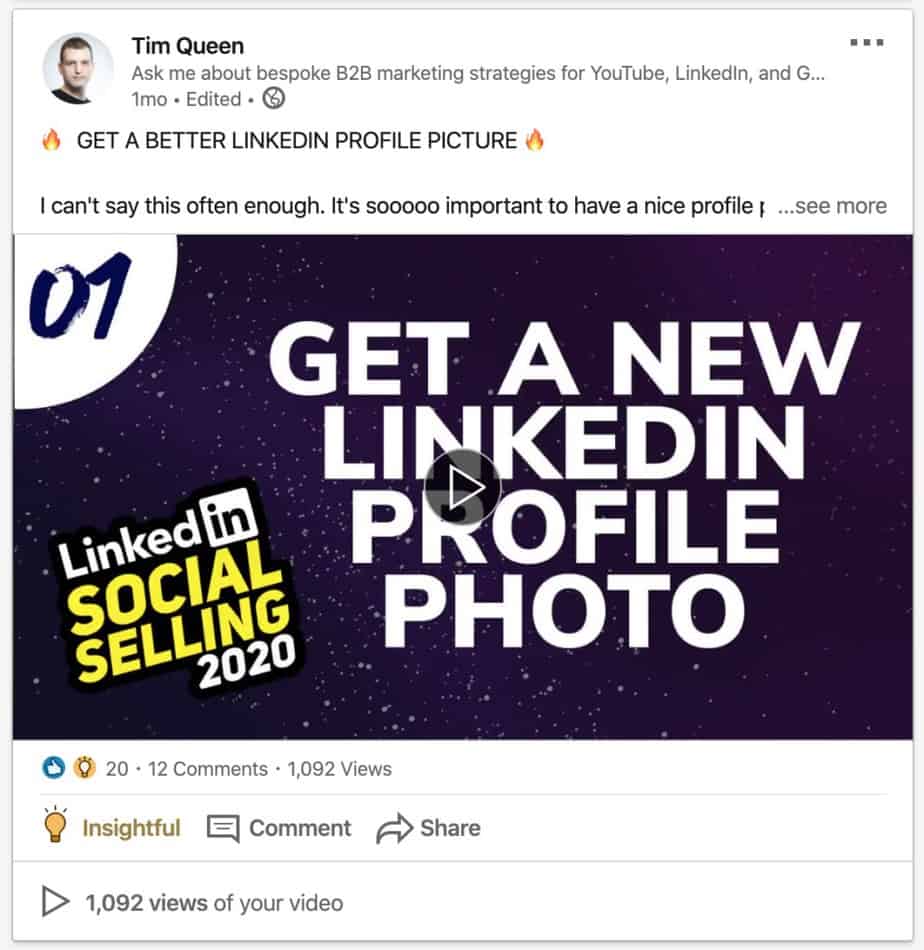
Today, videos have a comparable organic reach to text and photo posts.
Videos tend to attract a very different audience than text and photo posts. That's why I am including videos in my LinkedIn content mix strategy.
Uploading LinkedIn documents
Shortly after videos, a new content format became the new favorite of the LinkedIn newsfeed algorithm. Documents.
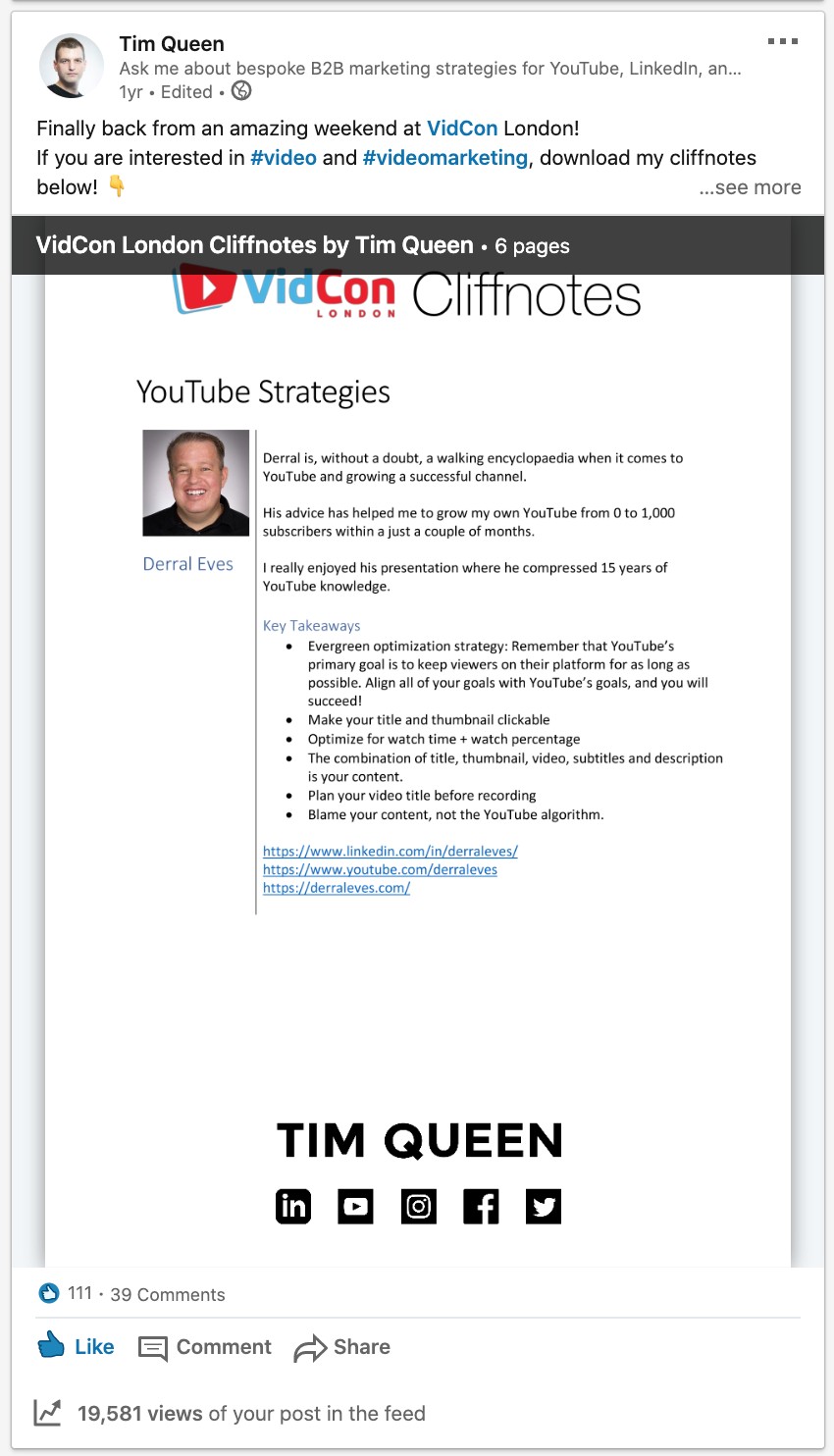
LinkedIn made it possible to share PowerPoint presentations, Word documents, and PDFs among other content types natively in its news feed without the need to use a platform such as SlideShare.
Documents have infinite potential and there are many cool ways how you can use them to generate high-profile customers for your business.
A document post is also known as the carousel post. You can learn the basics on how to create LinkedIn Carousel Posts in Canva here.
Live streaming on LinkedIn
One of the newest LinkedIn content types is Live Streaming. This feature is still in beta and only available on the application only.
If you are comfortable recording LinkedIn videos, you will enjoy LinkedIn live.
Especially now that remote learning and virtual events become more and more popular, LinkedIn live is one of the most powerful tools at your disposal.
Organizing events on LinkedIn
The ability to create and share online and offline events on LinkedIn has recently been re-introduced to its members.
It allows the creation of dedicated event pages for any event, from running a webinar up to a multi-day conference.
Events can be shared as posts on LinkedIn. At the moment there is no special prioritization of event posts over other post types in the LinkedIn newsfeed.
LinkedIn events give you the ability to ask for your audience's contact information, such as first and last name + their email address.
If you have access to LinkedIn live, you can directly link it to one of your events.
LinkedIn stories
(Update: LinkedIn retired LinkedIn Stories from 30 September 2021 onwards and the feature does not exist any longer.)
LinkedIn's latest attempt at mirroring social media networks such as Instagram and Facebook is its own version of stories.
LinkedIn allows you to share photos and short video clips of up to 20 seconds in combination with stickers such as animated GIFs and personal mentions of people and brands. Stories disappear after 24 hours.
At this time, LinkedIn has finally added a swipe-up feature, that would allow embedding links within your stories. But you are able to receive direct messages from connections, directly from within stories.
Optimizing your LinkedIn profile
One of the most important things that you can do to get better results on LinkedIn is to optimize your LinkedIn profile.
Before, you could get away with a half-optimized profile, because of the huge amount of viral traffic.
Now, that the numbers are down so much, you have to make every visit count.
- Get a professional headshot photo
- optimizing your LinkedIn headline
- by uploading a professional header image
- and keeping each section up to date.

High-quality content engagement to expand your reach on LinkedIn
Today you need more and higher quality engagement.
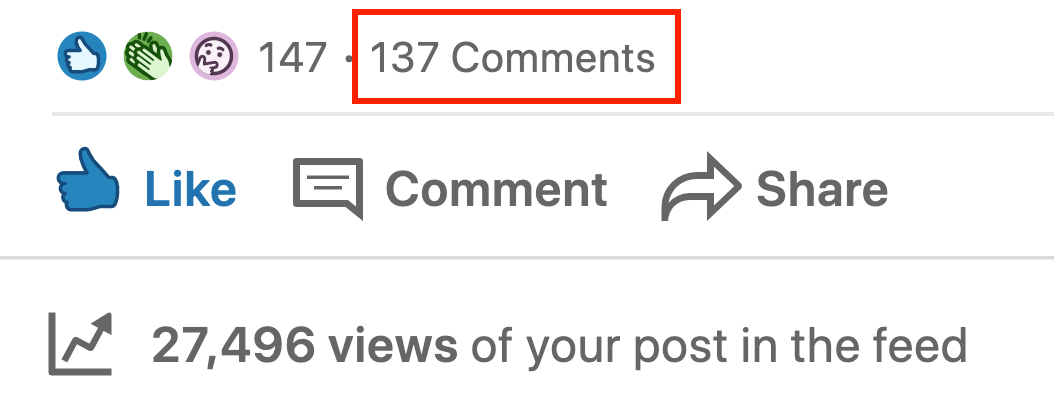
To get more people to engage with your content in a meaningful way, you have to engage with people who are commenting on your posts as well, so they are more likely to see your content in their newsfeed too.
What works well are content creator alliances between related, but non-competing businesses, that share common goals and similar audiences.
By engaging with each other's content it's possible for everyone to grow together.
Get your entire team involved
A similar very effective approach is an in-house employee advocacy program. This works best for larger companies with huge sales and marketing teams.
By engaging with your LinkedIn company page posts and user-generated content from employees, the company as a whole can supply the initial engagement necessary for a post to show up in more people's newsfeeds.
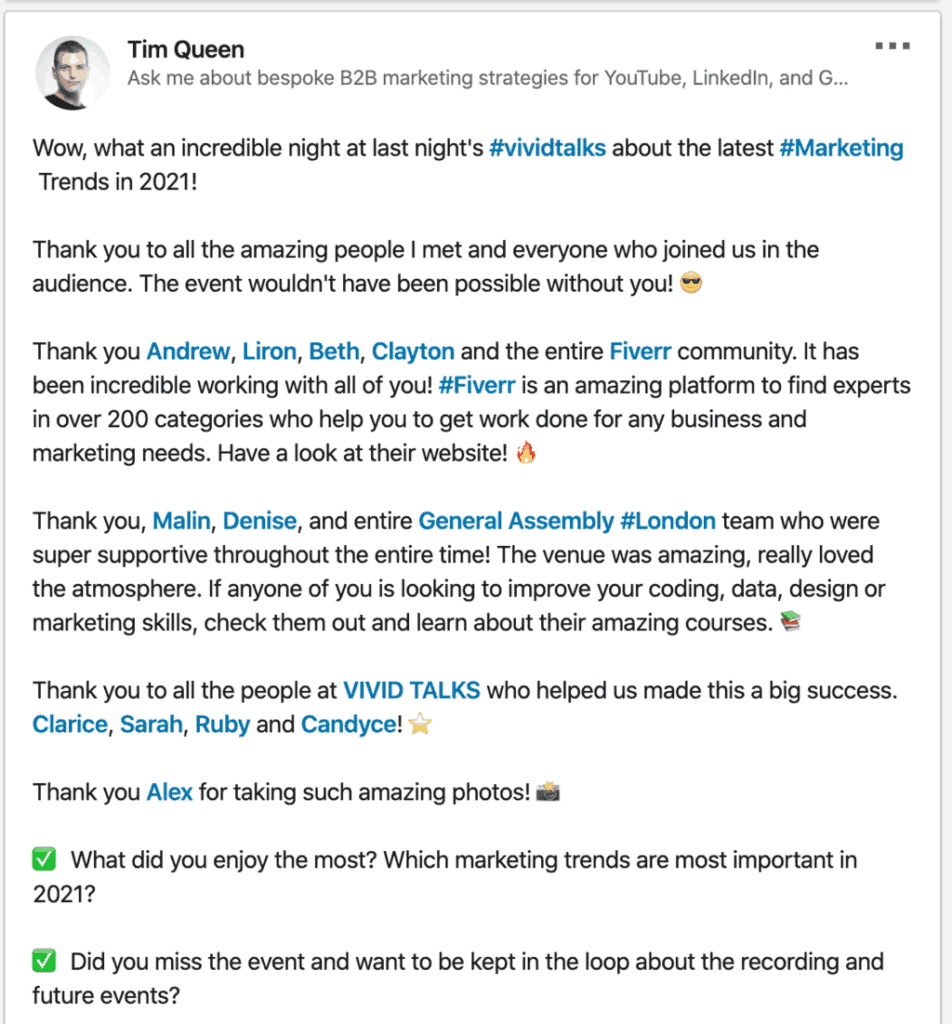
Tag your LinkedIn connections to get their attention!
If you don't have access to an elaborate content distribution network you can simply tag relevant people in your post or in your comment sections.
They'll receive a notification, even if the news feed wouldn't have shown them your post in the beginning.
Be wise, use this sparingly and only if the content is relevant to people.
Otherwise, they might unfollow you or even worse, disconnect with you - due to your spamming.
Real dialogue, real conversations
Next, we have to get back to basics.
More networking + more one-to-one communications.
Interacting with other people on LinkedIn dramatically increases the probability of your content showing up in their newsfeed.
Remind yourself of the evergreen approach to marketing and selling. It all comes down to human interactions.
You have to talk to people. Get their email address and contact information. Follow up. Get them on the phone or meet them in person. Build a relationship and close the deal.
Build a powerful LinkedIn sales funnel
It's also very important that you have a proper LinkedIn Sales Funnel if you want to grow your business fast on LinkedIn.
I love to create educational sequences for my ideal audience to educate them and to knock out specific beliefs that are standing in the way of buying from me.
This works best with a combination of content and email marketing.
To collect their contact information you have to create an attractive opportunity or lead magnet for them. This can be an ebook, a case study, a webinar or a calculator.
The Ultimate Strategy for Success With Organic Reach on LinkedIn
In summary, the organic reach on LinkedIn is down dramatically.
LinkedIn is prioritizing LinkedIn Ads, internal promotions, LinkedIn Influencers, content from their internal editorial team and publishing partners.
User-generated content has to work harder to get the same reach.
LinkedIn automation and engagement pods don’t work.
The good news is, you can still get incredible results with content marketing on LinkedIn if you are smart about it.
If you want to learn my complete A-Z system on how to get high-quality customers on LinkedIn, then join my LinkedIn Accelerator Program today.